cv-photo · 9 min
January CV photo: standing out in the post-holiday flood
January and February concentrate an executive application peak. How a well-calibrated photo doubles your callback rate in the mass.
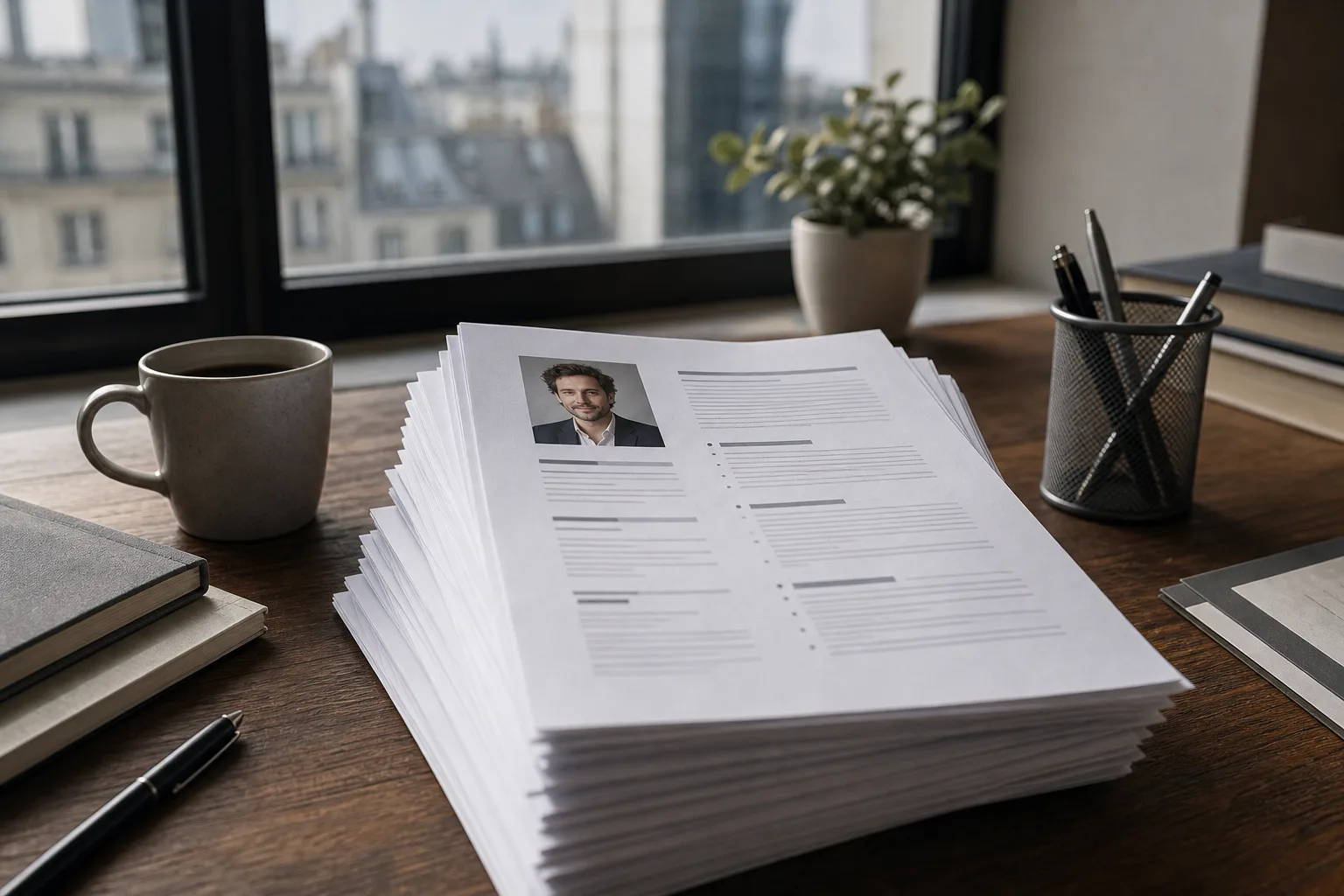
Every start of year, HR departments see their inboxes overflow. Year-end review, bonuses paid, January resolutions: the combination triggers an executive application peak that runs from mid-January to mid-March. If you apply at that moment, you're not facing a recruiter. You're facing a pile.
Your photo isn't a decorative detail in that pile. It's the first signal that decides whether the CV makes it past the initial six seconds or joins the pile below.
The January wall
Executive recruiting seasonality has been documented by Apec since 2020. In Q4 2025, only 8% of companies hired at least one executive — the lowest level since measurements began. A recovery of intentions is expected from Q1 2026, driven by large companies and mid-caps.
On the candidate side, the movement is reversed but synchronised. 40% of executives say they want to change companies within twelve months, three points more than a year earlier. When offers and candidates concentrate at the same time, the mass of CVs sent explodes mechanically between January and March.
Direct consequence: your CV is no longer read, it's scanned. And the photo is the first thing the eye sees.
Six seconds to exist
The reference study remains The Ladders', relayed by ManpowerGroup France: a recruiter spends on average six seconds on a CV during the first sort. Six seconds to decide between the "callback" pile and the "archive" pile.
Of those six seconds, recruiters devote 80% of the time to four elements: the name, the current role, the previous role, the education. The photo isn't on that list. But it conditions the first fraction of a second — the one where the eye decides whether the page deserves the next five seconds.
That's exactly the role of a visual in an editorial layout: an entry point that directs the gaze. If the entry point is broken (weird framing, busy background, blurred expression), the rest of the CV won't be read.
What makes the scroll stop
When a recruiter strings 200 CVs together in a morning, their eye gets used to it. They develop an automatic filter that eliminates what looks like what they just saw. To pass this filter, your photo must have three simple qualities:
Clean framing. Head and shoulders visible, no crop above the forehead, no torso cut in two. The rule of thirds also works for a square or rectangular photo.
Neutral but not empty background. A pure overexposed white tires the eye after the tenth occurrence. A soft grey, a lightly textured background or a blurred office creates contrast without overloading.
Composed expression. A natural closed smile, frontal gaze, straight shoulders. The photo must look like the person who'll show up to the interview, not their Instagram version.
These three criteria are the same year-round. What changes in January is the exposure frequency of the recruiter to mediocre photos. Their tolerance drops. What passed in September doesn't pass in February.
Three photo mistakes that drown you in the back-to-work pool
Mistake 1: the cropped holiday photo
The worst January classic. You have a nice Christmas family photo, you crop it tight, you stick it on your CV. The recruiter immediately sees the residual tan, the suspect blurred background, sometimes a bit of a relative's shoulder. Negative signal: you made your CV in five minutes.
Mistake 2: the photo over five years old
The classic trap. The photo may have been well done at the time, but the gap with your current appearance shows up in the interview. The recruiter sometimes detects it before even meeting you, just by crossing your recent LinkedIn photo. Credibility damaged from the start.
Mistake 3: the unprepared smartphone selfie
Extended arm, backlight, distorted perspective, slightly raised eyebrow. On an amateur site, that passes. On an executive CV in January 2026, it looks like a call for help. Not because the photo must be done in studio, but because it must be intentional.
A January CV photo must signal: "I prepared my application", not "I clicked between two Galette des Rois slices".
The back-to-work photo briefing: freshness without naivety
The goal isn't to look different from the rest of the year. It's to look fresh. The nuance matters. Here are the parameters to adjust.
Light. Favour a soft natural source, ideally facing a north-facing window. Hard winter light easily gives a tense face on smartphone. If you shoot indoors under artificial lighting, pick a warm light (3000-4000 K) rather than the cold ceiling LEDs.
Outfit. Avoid the thick turtleneck that eats the neck and crushes the shoulders. A simple shirt, a fine knit or an open blazer: the silhouette stays readable even at LinkedIn miniature or CV thumbnail size.
Colours. January is saturated with greys and navy blues — colours of coats, sky, screens. A slightly coloured top (burgundy, fir green, camel) catches the eye without shouting. Avoid bright red and neon yellow, signals too aggressive in a pile of 200.
Expression. Closed smile, calm frontal gaze. Not the open-teeth smile of summer photos. The back-to-work photo must say "I'm available and operational", not "I'm back from the Maldives".
Prêt à essayer ?
Refresh my back-to-work photo →Renewing your photo after the holidays: why now
Three practical reasons to redo your photo between mid-December and mid-January, even if the previous one isn't old.
You've changed physically without noticing. Haircut, beard, glasses, visible weight gain or loss. December is a natural break in the mental calendar. Use it to realign your image and your CV.
The sector has moved. A company that wore suit-and-tie two years ago wears open shirt today. Your photo must reflect the current code of the sector you target, not the one from three years ago.
The market is attentive to the "renewal" signal. An executive who recently changed their photo signals investment in their visibility. It's a weak but repeated signal, subconsciously read by recruiters who have followed you for several cycles.
Career change case: a photo that says "I worked over the holidays"
If you're in a career change and you apply in January, your photo plays a double role: signal your seriousness and signal your new profession. A photo that still looks like your old role sabotages your application before it's read.
The trade-off is concrete:
- If you're coming out of a sales role and targeting tech, break the sales codes (suit and tie) without falling into the hoodie cliché. Plain shirt, no tie, neutral light background.
- If you're coming out of teaching and targeting the private sector, add a blazer but keep a warm posture. The leader's firm smile can come across cold.
- If you're coming out of salaried work and targeting freelance, lightly textured or blurred office background, warmer light. You must make people want to call you, not brief you.
The quick method when time is short
The January trap is that the application peak arrives before you've had time to organise a studio session. Three options.
Express studio. In Paris and major cities, several studios offer 30-minute sessions at €75-150. Delivery time: 48-72h. Doable if you start before 5 January.
Prepared home selfie. Possible if you know how to frame, if you have a north-facing window and a neutral background. Count 30 minutes to shoot about a hundred photos, then 15 minutes to retouch the final selection. Limits: light consistency, smartphone perspective, retouching.
AI photo from a selfie. The fastest option. You upload a decent selfie, you pick the render (frame, outfit, background), and you get an editorial version in under a minute. Honest limits: likeness is never perfect, skin texture can appear smoothed, certain accessories (very thin glasses, jewellery) get warped. Ideal for a one-off refresh during peak, to complete with a real studio session when you have time.
SelfiePro works on this last model. European infrastructure (Firebase europe-west4), selfie not stored on our servers, explicit Gemini processing, HD file deleted within 90 days. If the back-to-work catches you off guard, it's a quick on-ramp not to send your 2022 photo on 80 applications.
What your photo must signal in a pile of 200 CVs
To summarise, here's the recruiter's mental grid in January, without sugar-coating.
| Signal read | Photo that triggers it |
|---|---|
| Seriousness of preparation | Clean framing, neutral background, outfit consistent with the sector |
| Mismatch / amateurism | Cropped holiday photo, extended-arm selfie, cropped group photo |
| Dated | Hair or glasses from another era, low image quality |
| Authentic but pro | Closed smile, frontal gaze, upright posture without stiffness |
| Credible career change | Visual codes of the new sector, without staging excess |
| Too "marketed" | Overplayed pose, obvious Photoshop background, extreme skin retouch |
The goal isn't to have the prettiest photo in the bunch. It's to have a photo that triggers no negative signal in the six seconds of scanning.
The pile test
Before sending your application, do a simple test. Open ten recent CVs (LinkedIn, school sites, public application examples in your sector). Put your CV in the middle. Look at the set for ten seconds. Ask yourself a single question: "If I had to eliminate half without reading anything, which ones do I keep?"
If your CV isn't in the five kept visually, your photo and layout have a problem. Redo them before sending anything. In January, the cost of a mediocre photo isn't a "less good result" — it's total invisibility.
The HR back-to-work rewards those who prepared. Your photo is part of it.
Read next.
photo-developpeur-freelance
Freelance developer photo: look credible on GitHub and LinkedIn
GitHub, LinkedIn, portfolio: the right freelance developer photo should signal reliability, clarity, and collaboration, not a staged tech persona.
creative-freelance-photo
Creative freelance photo: signalling your style
AD, motion designer, graphic designer: your photo must show your style without falling into the creative cliché. Method and concrete examples by trade.
interior-designer
Interior designer photo: show the method, not just the decor
Portfolio, LinkedIn, client proposal: how interior architects and designers can choose a photo that builds trust without looking like a furniture ad.