accountant-photo · 8 min
Accountant photo: reassure a business owner before the first meeting
LinkedIn, team page, proposal deck: an accountant's photo should project rigor, calm, and clarity before a client conversation even starts.

Business owners judge an accountant before the first meeting. They often start with Google, the firm's website, LinkedIn, and sometimes a proposal PDF. Your photo has to communicate three things immediately: rigor, clarity, reliability.
The right portrait should not look like private banking theater or generic LinkedIn coaching. It should reassure without feeling cold, signal method without stiffness, and stay consistent across the team page, LinkedIn profile, and client-facing documents.
Why does the photo matter so much for an accounting firm?
In professional services, buyers no longer rely on referrals alone. They check you out. Hinge's Visible Experts: Accounting & Financial Services Edition reports that 83.8% of buyers look at a provider's website before hiring, and 71% cite LinkedIn as the most-used social platform when evaluating an expert or firm.
For accountants, that behavior matters even more. The client is not buying a product. They are handing over a sensitive part of business control: cash flow, compliance, closing, payroll, tax, reporting, or strategic finance support. If the portrait looks generic, over-retouched, or out of sync with the rest of the firm, it creates unnecessary friction at the very start.
Which visual signals does a business owner read in one second?
An effective accountant portrait works when it sends four simple signals.
1. Precision
Clean clothes, stable framing, quiet background, controlled light. Nothing flashy. Business owners instinctively connect visual mess with operational mess. A badly fitted jacket, cluttered room, or yellow webcam cast all suggest avoidable sloppiness.
2. Accessibility
Accounting requires rigor, but clients are not looking for a hostile controller. They want someone who can explain, sort, and advise. The face therefore has to stay open: direct gaze, light smile or composed expression, relaxed shoulders.
3. Sector fit
The visual code for an accountant is not the code for a SaaS salesperson or a litigator. Shirt, fine knit, understated jacket, discreet office background or neutral wall: the right register feels professional without looking staged.
4. Continuity
The person seen on LinkedIn should be recognizable on the firm website, inside the proposal deck, and at the real meeting. LinkedIn itself says your profile photo should look like you “if they met you tomorrow,” and recommends a face that fills about 60% of the frame.
The 3 surfaces you need to align
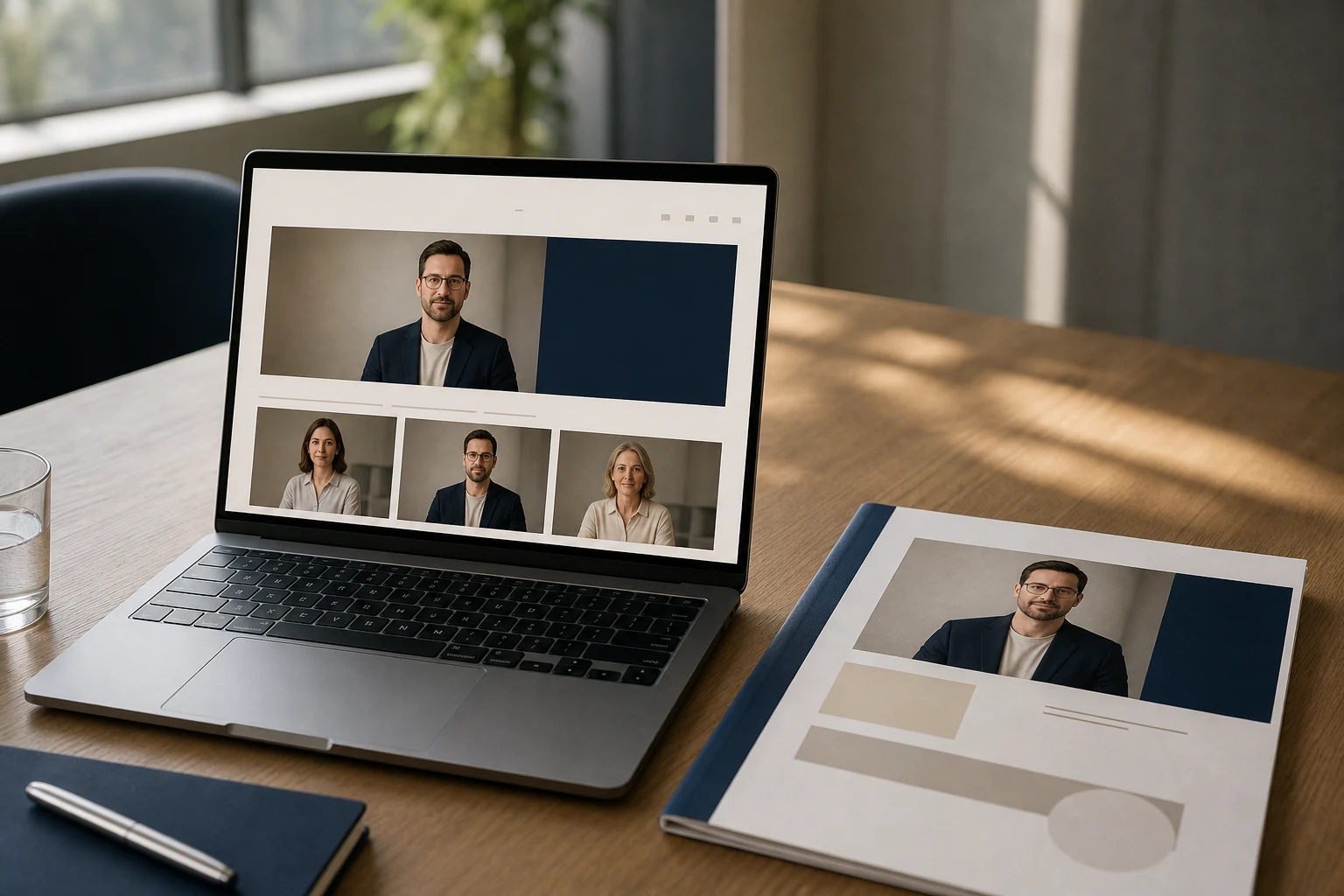
The problem is not just having a good-looking headshot. The real issue is having the same visual system everywhere the prospect checks you.
LinkedIn: the entry point
LinkedIn helps prospects verify who you are, your level of experience, and your professional tone. Here, the photo can be slightly more personal than the team-page version, but it still needs to stay sober. No heavy filters, no selfie, no vacation background, no rough crop.
The firm team page: institutional proof
On the website, the portrait no longer speaks only for you. It speaks for the firm. If each partner or manager appears photographed in a completely different visual universe, the brand feels improvised. Shared light, framing, and palette create an impression of order before the services copy is even read.
Proposal deck or engagement PDF: the turning point
When your portrait shows up again inside a proposal, it becomes a recognition marker. The business owner thinks, “yes, that's the same person I saw on the website and LinkedIn.” That visual repetition reassures. It makes the firm feel concrete, not abstract.
What does a good accountant portrait look like?
The effective image for this profession is neither cold nor “salesy.” It lives in the middle.
| Element | Works well | Creates noise |
|---|---|---|
| Framing | chest-up or shoulders, steady gaze | overly wide shot or aggressive tight crop |
| Background | neutral wall, blurred office, calm meeting room | cliché bookshelf, busy open space, forced luxury décor |
| Light | soft daylight or discreet studio light | flat webcam light, hard flash, backlight |
| Expression | calm, clear, available | selling smile, closed face, evasive eyes |
| Outfit | simple blazer, shirt, fine knit, muted colors | overly rigid outfit, loud patterns, overly casual look |
The subtle point is this: accountants do not need to impress visually. They need to inspire confidence.
The right accountant portrait does not say “look at me.” It says “you can trust me with something serious.”
Useful variations depending on the role
Independent accountant
The portrait can be slightly more personal. You are the firm, so your face carries a large part of the brand. Neutral background or meeting room, simple outfit, a little warmth in the expression. The goal is to reassure a small-business owner who wants a clear human contact.
Partner in a structured firm
The photo can become more institutional, but not rigid. Cleaner jacket, more controlled background, steadier framing. The implicit message is governance, method, control. Avoid the “investment banker” register if the firm mainly works with owner-led SMEs.
Client lead, outsourced CFO, strategic finance advisor
Here you can lean slightly more strategic. Meeting room, a bit more editorial light, more assertive posture. But the face still has to stay readable and human: the client is buying advice, not a character.
The mistakes that break trust
Three error families show up again and again.
The over-stock look
Nielsen Norman Group notes that users distrust corporate images that feel too perfect or generic, and prefer visuals that genuinely reflect the organization. On an accounting-firm site, an ultra-smooth smile against an artificial background can feel like a façade.
The outdated portrait
Ten-year-old photo, old haircut, old glasses, face that no longer matches reality: the gap comes back at the meeting. Even if the prospect never says it, they register the mismatch.
The overly commercial portrait
Big sales smile, exaggerated openness, shiny jacket, over-smoothed skin: that register may work in pure sales roles. For accountants, it muddies the signal. Clients want stability, not closing energy.
AI or photographer for this type of portrait?
Both have a role.
A photographer remains the best option when you need to harmonize a full team, produce multiple crops, or build a premium team page. AI becomes practical when speed matters, when you need to test different formality levels, clean up the background, standardize the light, and create a consistent version from a decent selfie.
The ethical rule is simple: the image has to genuinely look like you. It can improve the setting, but it should not invent another person or a fake firm environment.
Prêt à essayer ?
Create a sober, credible accountant photo →Checklist before publishing your photo
- The face is immediately recognizable.
- The photo looks like the person clients will actually meet.
- The crop stays readable at thumbnail size.
- The background does not steal attention.
- The outfit matches the client base you serve.
- The same visual direction exists on LinkedIn, the website, and proposal documents.
- Retouching improves the image without artificially smoothing it.
FAQ
Should an accountant smile in their photo?
Yes, but lightly. The right register is approachable and composed, not sales-driven. A restrained smile opens the relationship without removing the seriousness the role requires.
Can I use the same photo on LinkedIn and on the firm website?
Yes, if it is neutral enough and technically strong. Otherwise, use the same session and create two very close versions: one slightly more personal for LinkedIn, one slightly more institutional for the team page.
Is an office background mandatory?
No. A neutral wall or softly blurred meeting room works very well. The background does not need to “show accounting.” It simply needs to avoid distraction and avoid feeling fake.
Is an AI portrait credible for an accountant?
Yes if it stays faithful to the person and if the result is neither too glossy nor too dramatic. In this profession, credibility matters more than visual effect.
Sources
Read next.
photo-developpeur-freelance
Freelance developer photo: look credible on GitHub and LinkedIn
GitHub, LinkedIn, portfolio: the right freelance developer photo should signal reliability, clarity, and collaboration, not a staged tech persona.
creative-freelance-photo
Creative freelance photo: signalling your style
AD, motion designer, graphic designer: your photo must show your style without falling into the creative cliché. Method and concrete examples by trade.
interior-designer
Interior designer photo: show the method, not just the decor
Portfolio, LinkedIn, client proposal: how interior architects and designers can choose a photo that builds trust without looking like a furniture ad.