ai-professional-photo · 13 min
Pro photo: AI or studio photographer? 2026 comparison
Price, quality, turnaround, likeness, rights: comparing a Paris studio session vs an AI professional photo generator across 7 measurable criteria.
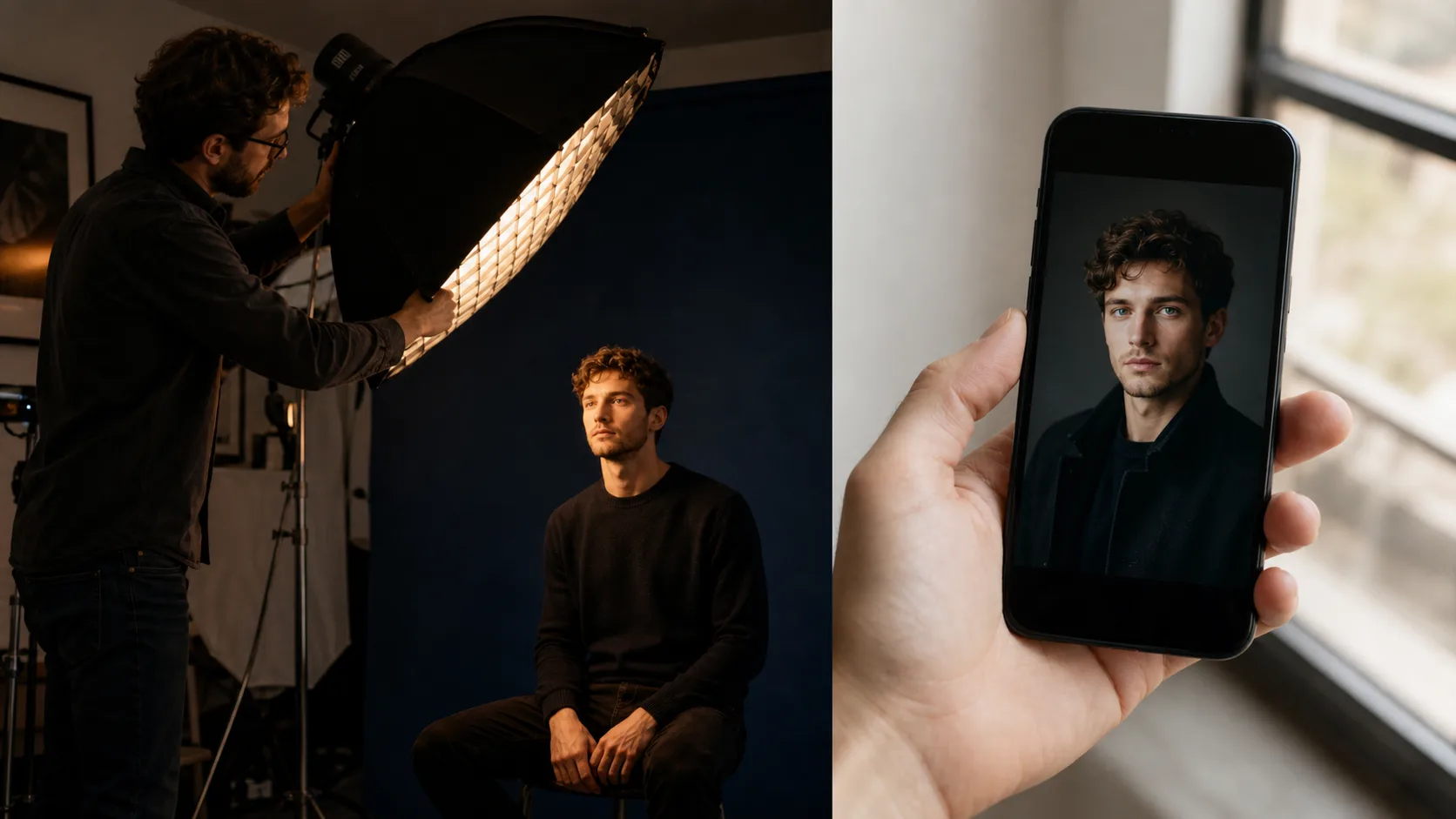
Choosing between a photographer and an AI generator for your pro photo is no longer a question of raw quality. It's a question of use, budget and risk tolerance. The studio delivers an image you control end to end. AI delivers ten images in two minutes for the price of a coffee. Both have their blind spots.
This comparison relies on 2026 public rate cards, the CNIL doctrine on generative AI, and real use of both solutions in French contexts (LinkedIn, CV, freelance portfolio, consulting firm directory).
The 2 options today
Classic studio session: what you actually buy
When you book a portrait session in Paris, you don't buy an image. You buy shooting time, art direction, controlled lighting, editorial selection and a certain number of retouches. According to Studio Art Photographe, a very short session starts at €40 for a single photo (10 minutes in express studio), and climbs to €200-600 for an hour in studio or outdoor with selection and retouches included.
Beyond €600, you pay three additional things: comfort (several outfits, several moods, makeup support), extended commercial usage rights, and the signature of a recognised studio. Studio Harcourt for example starts around €1,750 for an individual Portrait Prestige (2h session, makeup, an art print signed 24×30 cm under mat, low-res digital file).
AI photo: how it works technically
An AI professional photo generator takes your selfie as reference and produces a new portrait based on an image model (Gemini, Stable Diffusion, proprietary models). You don't re-photograph your face: the model composes a coherent image from the traits it detects, the chosen style (frame, outfit, light, background) and a prompt built server-side.
The final resolution is generally between 1024 and 2048 pixels on the long side. Generation takes between 15 and 60 seconds depending on the service. The material cost for the provider hovers around €0.10 to €0.15 per image (API call), which explains the pack or subscription pricing models.
Comparison on 7 criteria
Price: €40-1,750 studio vs €0-40 AI
Studio side, the French 2026 range goes from €40 (express 10-minute session, one retouched photo) to €1,750 and up for a Portrait Prestige Studio Harcourt or equivalent. The most-represented zone for a standard business portrait sits between €150 and €400, for 45 minutes to 1 hour of shooting, 5 to 15 retouched HD-delivered photos.
AI side, most generators bill between €0 and €40 for a pack of 10 to 50 portraits. Freemium services let you test before paying. Cost-per-image ratio goes from €0.10 to €5 depending on the pack and quality.
Turnaround: 1-2 weeks vs 30 seconds
Studio is a calendar. Booking, session, post-production: count 1 to 3 weeks between first contact and HD file delivery. Express studios shorten to 48 hours, but it's the exception.
AI delivers in real time. Selfie upload, style choice, generation in 15 to 60 seconds, immediate HD download. If you need a photo to update your LinkedIn before an interview tomorrow morning, it's the hardest argument to counter.
Technical quality and resolution
A photographer works in RAW, on a full-frame sensor, with light controlled to 1/3 stop. Native resolution exceeds 24 megapixels, sharpness is constant, dynamic range is usable for print uses (poster, brochure, banner). Skin retouch stays subtle, eyes are sharp, hair has detail.
AI delivers generally 2K (2048 pixels on the long side), enough for LinkedIn, CV, web profile, email signature, badge. For A4 print or more, the resolution becomes tight. Technically, an AI professional photo often beats the average amateur selfie in terms of light and composition.
Where AI falls short today is on typical generative artefacts. It must be said clearly: in 2026, AI-generated skin texture remains a weak point. The skin tends to come out too smooth, slightly waxy, with a micro-geometry that doesn't resemble real skin when you zoom to 100%. To this add the risky generation zones: hands (fused fingers, missed proportions, approximate nails), ears (asymmetries, poorly defined contour), glasses (arms disappearing behind the ear, lenses misaligned), repeated textile patterns (stripes that drift, knits that mix, distorted logos). Out of 10 generated portraits, you often need to throw 2 or 3 because of one of these defects.
The studio isn't exempt from defects either, just different. The classic trap: over-retouching. A photographer who pushes skin to 100% smoothing in post produces a plastic, over-smoothed image that reeks of retouching. It's particularly visible on the corporate LinkedIn portraits of 2015-2020 where the "doll skin" render was in fashion. A poorly calibrated studio photo can seem more artificial than a good AI generation. Fabric folds, micro-reflections in the eye, perfectly uniform backgrounds remain the studio's clean advantage on fine details.
Likeness: the limit of current AIs
It's the point where AI remains honestly perfectible. The model produces a portrait inspired by your selfie, not a photo of you in the strict sense. Depending on the quality of your source selfie (light, sharpness, angle), the result oscillates between very similar and "a distant cousin". The most sensitive zones: the exact shape of the nose, expression wrinkles, skin imperfections that make your identity.
Concretely, here's what happens depending on the selfie you provide. If your selfie is taken backlit (window behind you), the model doesn't see your face structure well and rebuilds "averaged" traits: you get someone who vaguely resembles you but isn't you. If source resolution is too low (less than 1000 px long side), the AI invents fine details (exact eyebrow shape, corner-of-eye folds), and that's where you slide toward "distant cousin". If your selfie is taken at smartphone wide angle 20 cm from the face, your nose and forehead are distorted by perspective: the AI learns this distortion as if it were your real morphology, and you get an elongated-nose portrait that doesn't look like you either. Finally, if you wear glasses in the selfie but ask for a generation without (or vice versa), the model must invent what's behind the lenses: the zone around the eyes becomes an approximation.
Conversely, a good-quality selfie (frontal natural light, smartphone held at arm's length, neutral expression, non-distracting background, native 12 MP resolution) yields very convincing results. That's exactly the terrain where AI performs: a clean input gives a similar output. You need to know it before uploading.
The photographer photographs you. Period. Likeness isn't a variable, it's the guaranteed minimum, regardless of your mood that day or the light in your living room.
Look variability
It's the terrain where AI takes a clean lead. In studio, you'll leave with 3 to 5 different moods (outfit, background, pose) maximum, because each change costs session time.
With an AI generator, you can test 10 styles in 5 minutes: dark suit grey background for corporate LinkedIn, white shirt blurred outdoor background for your freelance site, casual look for a podcast, black and white for a magazine. The marginal cost of iteration is almost zero.
Image rights and ownership
Studio side, by default in France, the photographer remains the author of the image under the Intellectual Property Code. You get a contractually defined usage right (web, print, duration). For extended commercial use (ad campaign, packaging), rights transfer is billed separately, sometimes hundreds of euros extra.
AI side, conditions vary enormously by service. Some grant you all commercial usage rights. Others reserve the right to reuse your image to train their models. Read the T&Cs before signing. It's the most poorly documented point of the market in 2026.
Beyond T&Cs, there's an often-ignored fundamental legal question: who actually owns the generated image? French doctrine, aligned with the US Copyright Office decisions of 2023-2024 and confirmed by several European decisions in 2024-2025, considers that a purely AI-generated work (without substantial human creative intervention) isn't protectable by copyright. Concretely: your AI portrait isn't a "work of the mind" under article L.111-1 of the IP Code, because no human author has made the creative gesture giving it its original character. The prompt itself can be considered a technical instruction, not a protectable creation.
The practical implications are concrete. If you use an AI professional photo on your site, anyone can technically take it back without you being able to invoke a classic copyright. You keep on the other hand image rights on your face (personality rights, independent from copyright): no one can commercially exploit your portrait without your agreement, even if AI-generated. For standard professional use (LinkedIn, CV, freelance site, email signature), these nuances have no operational impact. For ad campaign or product packaging use, better either lock by contract with the AI provider, or go through a photographer with classic rights transfer.
Privacy and hosting
For a photographer, your images are stored on their hard drives, on a pro cloud, sometimes published in their book. You can demand deletion, but without strong technical guarantee.
For an AI service, two questions to ask:
- Is my selfie stored, and for how long?
- Where is the data hosted (EU or outside EU)?
The CNIL recommends a strict framing of processing involving biometric data (a face is part of it), and favours European hosting when possible. It's a real fault line between serious players and others.
Recap table
| Criterion | Studio photographer | AI photo |
|---|---|---|
| Unit price | €40 to €1,750 | €0 to €40 per pack |
| Turnaround | 1 to 3 weeks | 30 seconds to 2 minutes |
| Resolution | 24 MP+ (print OK) | 2K (web and profile OK) |
| Likeness | Guaranteed | Variable, depends on source selfie |
| Varied looks | 3 to 5 max per session | 10+ in a few minutes |
| Image rights | Transfer to negotiate | Read T&Cs case by case |
| Data hosting | Photographer's drives | EU or outside EU depending on service |
Which option by profile
LinkedIn for executive director
If you lead a team, raise funds or speak to investors, go to a corporate photographer. The cost (€200-400) is marginal compared to the stakes, and perfect likeness counts. AI can serve as complement to quickly test several angles before the session.
Career-change CV
AI is unbeatable. You can test a "new sector" look without committing €300 to a photographer when you're not even sure of the target trade. Once your target is clarified, you can possibly move to studio.
Creative freelance portfolio
Hybrid case, and it's exactly the terrain I know best: art director for 10 years, I use both in my workflow depending on context. For the "About" page of my site, the main photo benefits from coming from a photographer (pro seriousness signal, image that holds over time). Concretely, I treat myself to a real studio session every 2-3 years for that photo: it's the visual signature that appears in client presentations, pitch decks, conferences. It must be irreproachable and durable.
For everything else — the Malt profile photo, the campaign LinkedIn banner, the Behance avatar, the email signature of the month, the guest podcast episode photo — the AI professional photo largely does the job. The interest in art direction/motion is being able to vary the photo tonality by project shown: "lifestyle branding" look for a brand-design-oriented portfolio, "clean dark studio" look for a premium motion portfolio, "outdoor natural light" look for a packaging and craft portfolio. A photographer won't do three different shoots for these variations, AI will. And the near-zero marginal cost lets you refresh these secondary photos several times a year without thinking.
Consulting firm directory
If your firm has a directory charter (uniform background, identical framing, consistent retouching), you have no choice: go through the photographer designated by the agency. AI will produce an image too different from your colleagues'.
Prêt à essayer ?
Try SelfiePro for free →The trap of US AIs for FR use
Most general-public AI generators are hosted in the United States, on AWS or Google Cloud in the American region. For a French selfie, that means a data transfer outside the EU, regulated at best by standard contractual clauses, at worst by nothing.
The CNIL published several opinions reminding that selfies enter the personal — even biometric — data perimeter depending on the processing done. For personal use, the legal risk is low. For corporate use (HR director wanting to homogenise team photos with an AI, agency photographing its salespeople), it's another story: without EU hosting and clear retention policy, you take a non-negligible GDPR risk.
A selfie is personal data, sometimes biometric. Choose your generator as you'd choose a GDPR subcontractor.
Concrete criteria to evaluate a French or European AI service:
- Hosting explicitly declared in EU
- Selfie not stored beyond processing (or short and documented retention)
- Clear retention policy for generated images (e.g. 90 days max)
- No use of the face to train models
Combining both: the hybrid strategy
The question "AI or photographer" is poorly framed. For most profiles, the right answer is "both, at different moments".
AI serves to iterate quickly: test a look before adopting it, vary photos across your secondary profiles, handle an urgent need, update your photo every 6 months without blocking a Saturday morning.
The photographer serves to fix your main image: the LinkedIn cover photo, the "About" photo of your site, the photo that will appear in the press or in a book. A good session every 2-3 years is enough to maintain a solid base.
Practically, that gives a controlled annual budget: a studio session every 2-3 years (€200-400 amortised), plus a subscription or AI pack for iterations between two sessions (a few tens of euros per year). Total: under €150 per year to have an up-to-date pro image on all channels.
It's precisely for this use case that we built SelfiePro: a French generator, hosted in the europe-west4 region, that doesn't store your selfie and keeps HDs 90 days maximum. For quick iterations between two real photo sessions, not to replace your photographer.
Read next.
photo-developpeur-freelance
Freelance developer photo: look credible on GitHub and LinkedIn
GitHub, LinkedIn, portfolio: the right freelance developer photo should signal reliability, clarity, and collaboration, not a staged tech persona.
creative-freelance-photo
Creative freelance photo: signalling your style
AD, motion designer, graphic designer: your photo must show your style without falling into the creative cliché. Method and concrete examples by trade.
interior-designer
Interior designer photo: show the method, not just the decor
Portfolio, LinkedIn, client proposal: how interior architects and designers can choose a photo that builds trust without looking like a furniture ad.