trust-photo · 9 min
Photo that inspires trust: what science actually says
Willis & Todorov study: trust reads in 100 milliseconds on your face. The proven visual markers and what they imply for your pro photo.
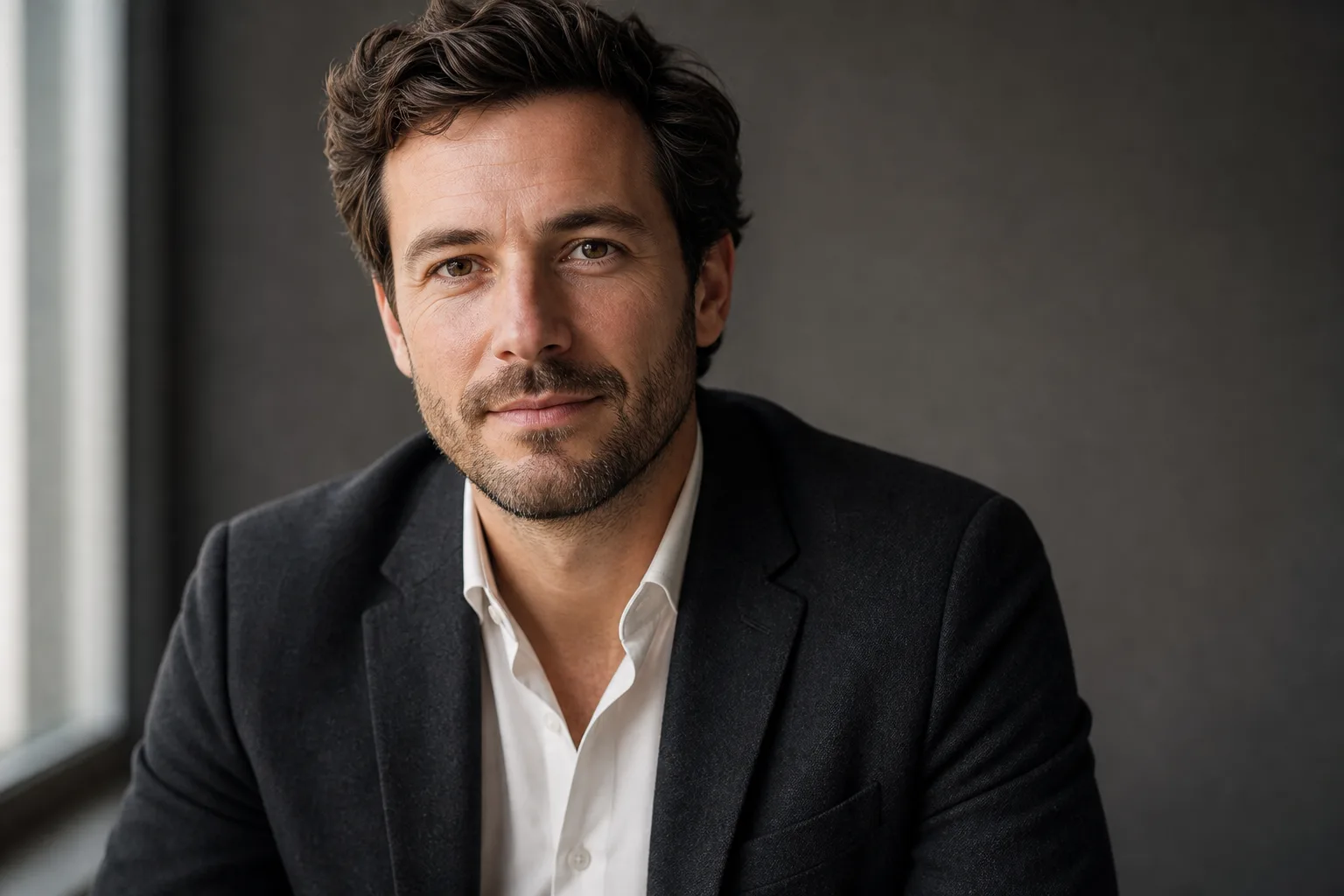
You open LinkedIn. In a blink, you've already decided if you trust the person facing you. Not in the sense "I'd lend them my car", more in the sense "I'm listening to what they say" or "next profile". This decision isn't rational. It's been measured in the lab. And it's faster than you think.
The visual markers that activate this judgement are identifiable. They're nothing mystical. This article goes through them, with scientific sources on the table.
The science: Willis & Todorov, judgement in 100 milliseconds
In 2006, two Princeton researchers, Janine Willis and Alexander Todorov, published in Psychological Science a study that has become a reference. The protocol is simple: participants are shown unknown faces for controlled exposure durations (100 milliseconds, 500 ms, 1,000 ms). Participants then rate five perceived traits: attractiveness, likeability, trust, competence, aggressiveness. A control group evaluates the same faces with no time constraint.
Main result: judgements formed after 100 milliseconds correlate very strongly with those formed without time constraint. In other words, giving the brain more time hardly changes the conclusion. The extra time strengthens the confidence the person has in their own judgement, but doesn't modify the judgement itself.
Among the five tested traits, trustworthiness is the one where the correlation between snap judgement and free judgement is the strongest. It's also the trait that weighs the most in the decision to engage a conversation, click on a profile, respond to a message. For professional online use, it's the trait to understand in priority.
Three important clarifications to not over-interpret these results. First, the study covers neutral lab face photos, not worked-on LinkedIn photos. Then, "strong correlation" doesn't mean "absolute truth": a trustworthy-looking face isn't necessarily trustworthy, the study measures perception, not reality. Finally, the researchers worked on an American student population, so with a cultural bias to keep in mind. This doesn't change the bottom-line conclusion: the decision is fast, and it plays on precise visual signals.
Visual markers associated with perceived trust
Todorov and his NYU team's later work (where he continued his research after Princeton) isolated the face components that push judgement toward "trustworthy" or "untrustworthy". Not all these markers are modifiable on a photo, but several are. Here are the five with documented effect that you can work on for your pro photo.
Moderate facial symmetry
Marked facial symmetry is associated with positive perception (health, genetics, attractiveness). But perfect symmetry, obtained by retouch or by too-frontal framing, quickly tips into the "uncanny" effect: the face becomes artificial, therefore less reliable. Practical rule: avoid retouches that smooth natural asymmetries, also avoid strictly axial framings forcing symmetry.
Duchenne smile
The so-called "Duchenne" smile, named after the French neurologist who documented it in the 19th century, is the one that activates both the muscles around the mouth (zygomatics) and those around the eyes (orbiculars). The small wrinkles at the corner of the eyes aren't a defect, they're the markers of the authentic smile. A mouth-only smile is perceived as social but distant. The Duchenne smile is perceived as sincere, therefore trustworthy. On a photo, it's hard to manufacture on demand: it comes better when the subject actually thinks of something that amuses or relaxes them.
Direct gaze orientation
A gaze toward the lens, stable horizontal axis, without diverting toward the ground or the side, is associated with perceived trust. A shifty gaze (eyes looking elsewhere at the moment of the shutter) triggers a distrust signal, even very faint, even unconscious. Simple test: the pupil must be vertically centred in the iris at capture time, not pulled up or down.
High shoulder posture
Shoulders pulled back, neck elongated, chin slightly lowered (but not tucked) signal a self-confident posture without aggression. Shoulders pulled forward, hunched back, signal timidity or apprehension. This point doesn't strictly concern the face but the body language captured by the classic portrait framing (chest + shoulders + head).
Eye-level framing
A photo taken above the subject (high angle) gives the viewer a dominance position: the subject seems smaller, less assured. A photo taken below (low angle) gives the subject a sometimes-excessive authority position, perceived as arrogant. Eye-level framing (the lens is at the subject's eye level) is neutral: it places viewer and subject on the same plane, which favours the perception of equality and therefore trust.
Perceived trust doesn't play on one detail, it plays on the accumulation of consistent signals.
The 4 antidotes to know
Conversely, certain visual signals actively push judgement toward distrust. Avoiding them matters as much as ticking the right boxes.
The forced smile. Mouth frozen in U, eyes that don't follow. It's readable in under a second. A relaxed neutral expression beats a commanded smile.
The lateral gaze. Eyes looking next to the lens, as if someone else just spoke to you in the room. It can be aesthetic in fashion photo, it's penalising in pro photo for professional online use.
The high-angle framing. Photo taken from above, subject looking up. "Selfie at arm's length" effect that infantilises the subject and weakens the perception of authority.
Poorly managed backlight. Face in shadow, light halo behind. The human brain is wired to analyse a lit face. When there's not enough facial information, default judgement tips toward distrust.
Prêt à essayer ?
Test my photo against the 5 markers →AI photo and trust: the gaze test
This is where an AI-generated photo can stumble, and we must be honest. Current models reproduce well moderate symmetry, eye-level framing, high shoulder posture. They correctly reproduce a visual smile. Where they still struggle is on gaze direction and on Duchenne smile authenticity.
An AI photo's gaze can be very slightly off-centre, or not express the micro-tension characterising a living gaze. The AI smile often activates the zygomatics without always activating the orbiculars the same way. On a pro photo, these are details. On trust perception, they're significant weighting points.
In practice, this means two things. On one hand, the source selfie matters more than you think: a selfie where you look squarely at the lens and smile authentically will give an AI photo that inherits these qualities. On the other hand, out of a dozen generated variations, prioritise selecting those where the gaze is squarely on the lens and the smile visibly activates the eye contour.
Practical application: LinkedIn, team page, About
The 5 markers apply everywhere a professional profile photo is consulted by someone who doesn't know you yet. Three use cases where the stakes are particularly clear.
It's the main terrain. Recruiters, prospects, partners arrive on your profile without context. The first 100 milliseconds decide if they scroll or stop. Absolute priority: eye-level framing, direct gaze, authentic smile. If you must sacrifice a marker, keep direct gaze at minimum.
Corporate site team page
The visitor instantly compares the team's faces to each other. If a single photo breaks a marker (lateral gaze, backlight, high angle), it stands out negatively by contrast. That's why visual uniformity matters so much: it's not just aesthetic, it's equality of treatment between team members on the trust judgement.
"About" page of an independent site
Coach, consultant, freelance, creator. The "About" photo is often the only photo of you on the site. It carries everything. A photo ticking the 5 markers anchors the visitor in trust even before they read a line. A photo missing three pushes the visitor to look for compensatory signals (testimonials, client logos) earlier than they otherwise would.
What science doesn't say
To stay honest, we must also name the limits of this literature. Willis & Todorov don't say that a trust-inspiring photo will make you better in an interview. They don't say ticking the 5 markers guarantees a higher response rate in outreach. They say one thing, but it's solid: the perceived trust judgement forms in 100 ms, it's stable, and it relies on identifiable visual signals.
The rest — converting this initial judgement into professional relationship, negotiation, mission — depends on what happens after the click. The photo opens the door. It doesn't sign the contract.
That's enough to justify devoting a bit more attention to it. No more.
Practical summary
If you want a single line to remember: smile that reaches the eyes, frank gaze on the lens, straight shoulders, eye-level framing, light that illuminates the face. Check these five points on your current photo. If three are absent, your photo works against you. If four or five are present, it works for you, in the first 100 milliseconds where it counts.
Main sources
Read next.
photo-developpeur-freelance
Freelance developer photo: look credible on GitHub and LinkedIn
GitHub, LinkedIn, portfolio: the right freelance developer photo should signal reliability, clarity, and collaboration, not a staged tech persona.
creative-freelance-photo
Creative freelance photo: signalling your style
AD, motion designer, graphic designer: your photo must show your style without falling into the creative cliché. Method and concrete examples by trade.
interior-designer
Interior designer photo: show the method, not just the decor
Portfolio, LinkedIn, client proposal: how interior architects and designers can choose a photo that builds trust without looking like a furniture ad.