recruiter-photo · 7 min
Recruiter LinkedIn photo: the face that makes candidates reply
Before the first screening call, candidates often see your LinkedIn profile. Here is how a recruiter photo can build trust without overplaying employer brand.

A recruiter's LinkedIn photo is not decorative. It is often the first human face a candidate associates with the company. A strong photo should say: "you can speak to me", "the process will be clear", and "I represent a serious organisation", without promising more than the company can actually deliver.
Recruiting is sensitive because it involves trust, personal data, and discrimination risk. The recruiter portrait should open the relationship, not manufacture authority or install a visual bias before the conversation begins.
Why does a recruiter photo matter in the candidate experience?
Before an interview, a candidate may see the recruiter in a LinkedIn invitation, email, careers page, outreach message, or video-call invite. At that point, they have not met the company yet. They read small signals: face, job title, tone of the message, profile consistency, and overall credibility.
LinkedIn says that adding a profile photo increases profile credibility because people can see who sends the connection invitation. For a recruiter, that mechanism is direct: the profile is not only personal, it becomes a company interface. If the portrait feels cold, blurry, outdated, or overly institutional, it can make the first contact feel more distant. If it is sharp, current, and approachable, it makes the first reply easier.
What signals does a candidate read before replying?
Approachability
The candidate should feel they can ask a question without being judged. Visually, that means an open expression, direct gaze, soft light, and framing close enough for the face to stay readable in a small LinkedIn thumbnail. A slight smile is enough. A large sales smile can feel false.
Process seriousness
A photo that is too casual can blur the recruiter's role. A photo that is too corporate can suggest a rigid process. The right balance depends on the sector, but the objective stays the same: show someone prepared, punctual, clear, and able to represent a clean recruiting process.
Neutrality
The portrait should not imply that the company expects one narrow style of candidate. Avoid closed visual codes: dominant posture, luxury setting, insider humour, noisy open-space background, or heavy filter. The photo should welcome several profiles, not validate one social model.
Which visual codes actually support employer brand?
Employer brand is not only colours and slogans. It is also how a candidate feels treated before signing. The recruiter photo should support a relational promise: clarity, respect, availability, and precision.
| Visual code | What candidates understand | Avoid |
|---|---|---|
| Natural light or soft studio light | human, readable, non-aggressive exchange | harsh neon, dramatic shadow, beauty filter |
| Calm office or meeting-room background | structured process, professional context | empty cold wall, messy open space |
| Outfit aligned with the market | recruiter credible in their sector | forced suit, overly personal look |
| Calm expression | availability and control | advertising smile, closed face |
| Face-and-shoulders framing | readable in thumbnail size | wide shot, tilted selfie |
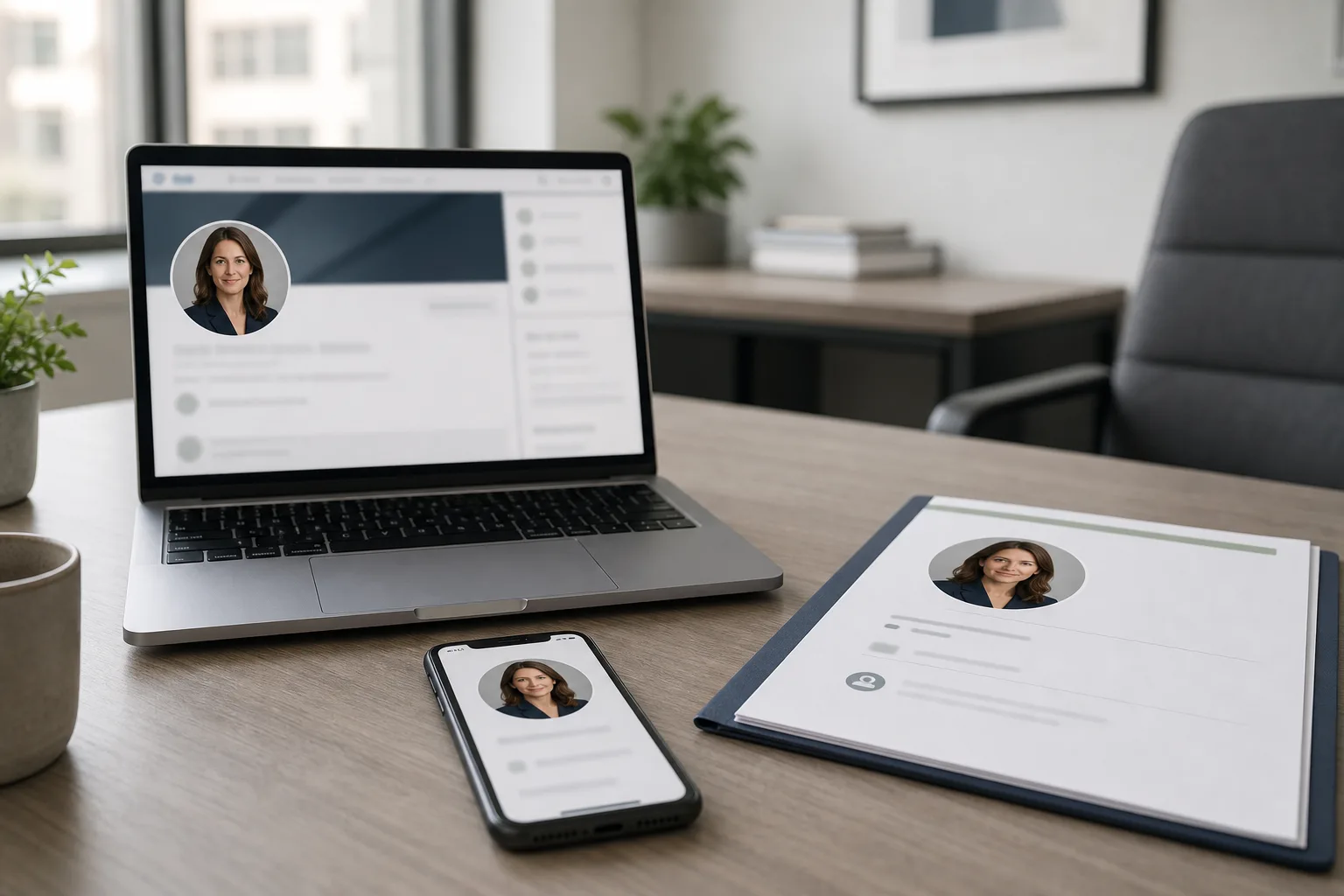
Where should this photo stay consistent?
This is often the most visible surface. The photo must work in a circle, at small size, with a clear face. If the recruiter contacts senior, international, or hard-to-hire profiles, restraint matters more than originality. The candidate should quickly understand that they are speaking to a real, identifiable, reliable person.
Email signature
An email signature with an inconsistent, cropped, or old photo creates unnecessary doubt. The message can be well written, but the image says: "this touchpoint is not controlled." A photo aligned with LinkedIn gives the opposite impression: continuity.
Careers page and team page
When a company shows its recruiters, the photo direction should avoid the improvised staff-grid effect. Same light logic, same level of formality, same approximate framing: it works like an editorial grid. If every portrait speaks a different visual language, the employer brand feels less controlled.
Video interview
The profile photo remains visible before the camera turns on, in a calendar invitation or video-call tool. It should prepare the real exchange, not create a more flattering character than the person who appears next. A strong photo reduces the gap between profile and meeting.
What is the ethical limit in recruiting?
In a French and EU context, recruiting involves personal data. CNIL notes that recruiters collect and use many candidate data points and that these operations must comply with the GDPR. Even if the recruiter photo does not process candidate data directly, it belongs to the same relationship moment: the moment where the company must inspire trust without opacity.
Appearance also requires care. For France, Service-Public explains that hiring discrimination is governed by labour-law references, and the Défenseur des droits has documented the role of physical appearance in employment-related discrimination. A recruiter photo should never suggest that the company evaluates professional value through appearance, style, age, or social conformity. The right message is: "we will assess your skills and track record", not "we hire people who look like us."
Quick photo brief for a recruiter or Talent Acquisition profile
- Recognisable, current face, faithful to the real person.
- Direct gaze, calm expression, slight smile.
- Simple professional background: office, meeting room, quiet HR space.
- Outfit compatible with the target candidates, without corporate costume.
- No required logo, no text in the image, no staged decor.
- Same photo or same visual direction across LinkedIn, email, careers page, and video calls.
- Sober retouching: improve light and framing, do not transform the face.
If you want to test a clearer version without reshooting, you can upload a photo and generate a professional portrait with a simple brief: approachable recruiter, natural light, calm office background, available expression.
FAQ
Should a recruiter smile in their LinkedIn photo?
Yes, but lightly. The smile should open the exchange, not sell fake closeness. A calm, attentive, recognisable face works better than a commercial expression.
Do recruiters need a very corporate photo to hire executives?
Not necessarily. For executive candidates, the main signal is process control. A sober jacket, clean light, and calm background are often enough. Too much staging can create distance.
Can an AI photo work for a recruiter?
Yes, if it stays faithful to the real face and work context. It can improve light, harmonise the background, and make the portrait more readable. It should not invent a setting, status, or misleading appearance.
Can the same photo work on LinkedIn and in an email signature?
Yes, and it is often the best option if the photo is recent and well framed. Repetition helps the candidate recognise the contact. Just make sure the image stays readable at small sizes.
Sources
Read next.
photo-developpeur-freelance
Freelance developer photo: look credible on GitHub and LinkedIn
GitHub, LinkedIn, portfolio: the right freelance developer photo should signal reliability, clarity, and collaboration, not a staged tech persona.
creative-freelance-photo
Creative freelance photo: signalling your style
AD, motion designer, graphic designer: your photo must show your style without falling into the creative cliché. Method and concrete examples by trade.
interior-designer
Interior designer photo: show the method, not just the decor
Portfolio, LinkedIn, client proposal: how interior architects and designers can choose a photo that builds trust without looking like a furniture ad.